
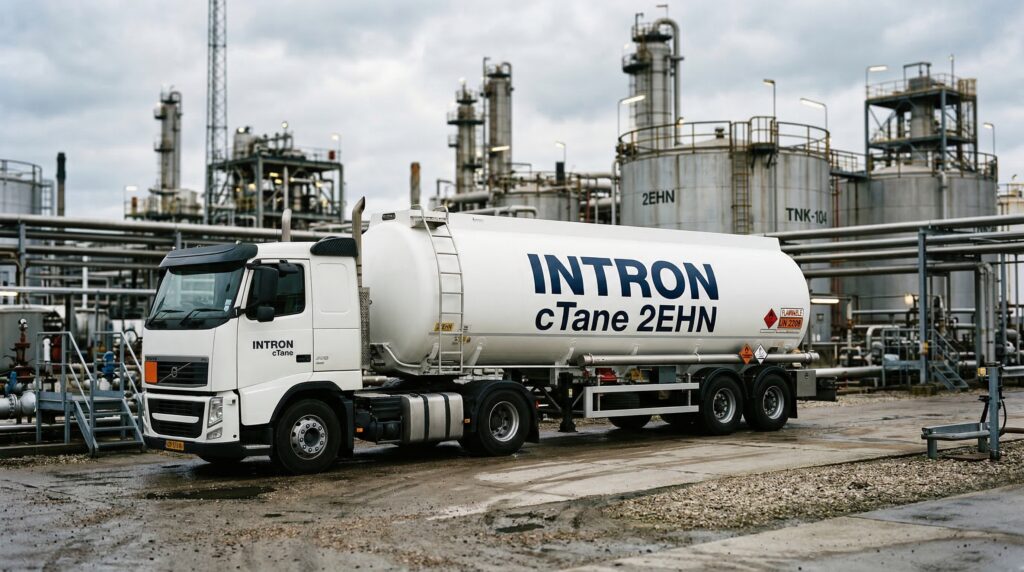
Cetane improver additives are among the most important tools in diesel fuel production. They raise the cetane number of diesel fuel, which directly controls how fast and cleanly the fuel ignites inside the engine. Without a sufficient cetane number, diesel engines run louder, produce more harmful emissions, and wear out faster. For this reason, refineries, fuel blenders, and fuel distributors rely on a certified cetane improver to bring their diesel fuel to specification — and to keep it there.
This page explains what cetane improvers are, why the global fuel industry needs them, and how INTRON® cTane — supplied by PETRONAX Europe GmbH — delivers proven ignition quality improvement across all grades of diesel fuel.
What a Cetane Improver Does and Why Ignition Quality Is Critical
The cetane number (CN) is the primary measure of diesel fuel ignition quality. It quantifies the ignition delay: the time between fuel injection and the start of combustion in the cylinder. A higher cetane number means a shorter delay. A lower number means the fuel waits too long before it ignites. As a result, unburned fuel accumulates in the combustion chamber before it finally ignites all at once.
That uncontrolled ignition event causes diesel knock: a sharp, percussive noise that signals mechanical stress and incomplete energy release. Furthermore, incomplete combustion generates elevated concentrations of nitrogen oxides (NOx), carbon monoxide (CO), and fine particulate matter (PM2.5). These are exactly the pollutants that Euro VI, EPA Tier 4, and equivalent regulations worldwide target. In addition, prolonged ignition delay accelerates injector fouling and shortens engine service life. Therefore, low cetane quality creates both an environmental and a financial burden.
The European standard EN 590 requires a minimum cetane number of 51 for road diesel. Premium and arctic-grade specifications require 55 or above. Many blending components — including catalytic cycle oils, hydrocracked distillates, and high-aromatic streams — fall naturally below these thresholds. Consequently, meeting the specification without additives is often impossible. This is precisely where a cetane improver becomes essential.
A cetane improver is a chemical additive that shortens ignition delay by intervening in the fuel’s combustion chemistry. Refineries and blenders add it at treat rates typically between 200 and 2 000 ppm. At these concentrations, the additive raises the measured cetane number of the finished fuel to specification. Moreover, it does this without significantly affecting other key properties such as density, viscosity, or cold filter plugging point. That makes it a precise and cost-effective solution.
How Cetane Improvers Work: The Chemistry Behind Faster Ignition
The mechanism of a cetane improver begins under the extreme conditions of diesel compression. At temperatures above 500 °C and pressures above 40 bar, the additive molecule decomposes thermally. This decomposition releases highly reactive free radicals. These radicals immediately start the hydrocarbon oxidation chain reaction that produces combustion. Specifically, they do so earlier in the compression stroke than the base fuel would achieve on its own.
As a result, ignition begins sooner. Combustion proceeds more completely. The uncontrolled pressure spike that causes diesel knock disappears. In addition, more complete combustion means less soot, less CO, and lower NOx output. Engines run smoother and quieter. Injection system components experience less thermal and mechanical stress. Therefore, the benefits of a cetane improver extend well beyond emissions: they also translate into measurable savings on maintenance and fuel.
The most proven compound in this product category is 2-ethylhexyl nitrate (2-EHN), an organic nitrate ester with decades of validated industrial use. 2-EHN decomposes reliably across all distillate grades, including ultra-low sulphur diesel (ULSD), biodiesel blends up to B20, gas-to-liquid (GTL) components, and winter arctic grades. Its response curve is well characterised, so refineries and blenders can predict the cetane number uplift at any given treat rate. This predictability makes 2-EHN-based cetane improver products the industry standard for controlled ignition quality management.
Furthermore, the global regulatory framework reinforces the need for this product category. EN 590:2022, ASTM D975, Euro VI, and IMO MARPOL Annex VI all set cetane minimums or emission limits that certified fuel must meet. In practice, compliant fuel production in many markets is not achievable without a cetane improver at some stage of the blending process.
INTRON® cTane: A Proven Cetane Improver Supplied by PETRONAX Europe
INTRON® cTane is a high-performance cetane improver formulated on the basis of 2-ethylhexyl nitrate and supplied by PETRONAX Europe GmbH. PETRONAX developed this product specifically for refineries and fuel distributors that need consistent, measurable cetane number uplift across demanding operational conditions. INTRON® cTane performs across all grades of road, off-road, marine, and arctic diesel fuel. It delivers reliable results regardless of the base fuel composition or blending complexity.
Measurable Impact on Engine Performance and Emissions
When PETRONAX customers treat diesel with INTRON® cTane, the combustion profile changes in measurable ways. Ignition delay shortens. Combustion becomes more complete. As a result, engines running on treated fuel produce up to 15% less NOx, alongside significant reductions in particulate matter and unburned hydrocarbons. In addition, diesel knock disappears: engine operation becomes quieter and smoother. Therefore, injection systems and engine components last longer, and maintenance intervals extend. For fleet operators, this directly reduces total cost of ownership.
Regulatory Compliance Across Major International Standards
INTRON® cTane enables diesel fuel to meet or exceed the standards that regulators and customers require. Specifically, it supports compliance with EN 590:2022 for European road diesel, ASTM D975 for North American markets, Euro VI emission limits for heavy-duty vehicles, and IMO MARPOL Annex VI for marine distillate fuels. The product is REACH-compliant. PETRONAX provides a full regulatory dossier including SDS, Certificate of Analysis, and technical data sheet as standard.
Supply Chain Designed for Industrial Customers
PETRONAX Europe supplies INTRON® cTane in IBC containers (1 000 L), ISO tank containers (20 000 L and above), and bulk tanker quantities. Bonded customs storage and T1 transit procedures are available through key European logistics hubs, including the ADPO terminal at Kallo, Belgium. Moreover, transatlantic shipments to North American markets use full AMS/ISF customs documentation for compliant import. In addition, PETRONAX provides technical dosage consultation so that customers achieve their target cetane number at the lowest possible treat cost.
Why a Certified Cetane Improver Is a Core Component of Modern Diesel Fuel Production
Cetane quality is not a secondary specification. It determines whether diesel fuel burns efficiently, whether emissions stay within legal limits, and whether engines operate reliably over their full service life. Therefore, selecting the right cetane improver is as important as any other decision in fuel formulation. Specifically, it must deliver predictable CN uplift, work across the intended fuel grades, and come with the regulatory documentation that customers and auditors demand.INTRON® cTane from PETRONAX Europe meets all of these requirements. It is a chemically proven, industrially validated cetane improver additive that raises cetane number reliably and reduces harmful emissions measurably. Furthermore, it is backed by flexible logistics, complete regulatory documentation, and dedicated technical support. As a result, refineries, fuel blenders, and distributors can produce superior diesel fuel — consistently and cost-effectively — in compliance with every major diesel fuel standard in use today. Contact PETRONAX Europe GmbH to request the INTRON® cTane technical data sheet or a dosage recommendation for your base fuel