
A reliable lubricity improver for low-sulfur diesel
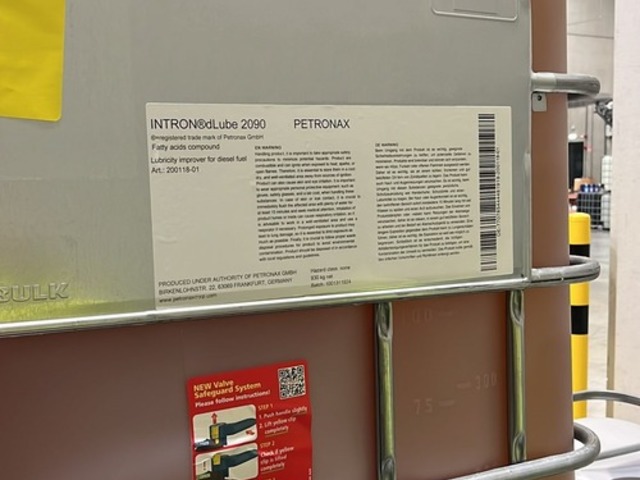
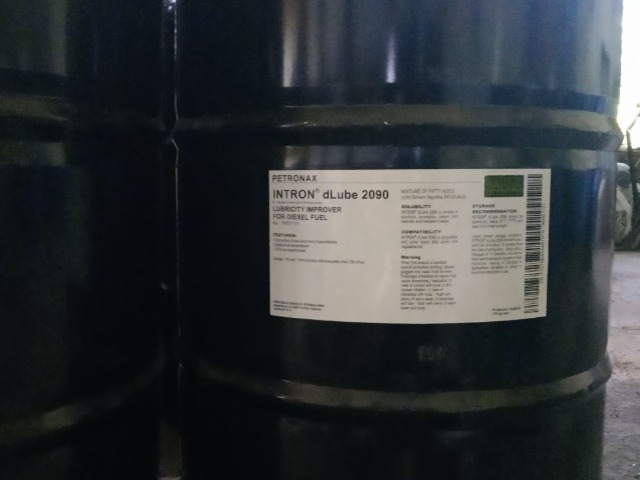
INTRON® dLube 2090 is a concentrated lubricity improver for low and ultra-low sulfur diesel and heating oil. Because the treat rate is low, it protects fuel pumps and injectors at a small cost. As a result, refiners, blenders and fuel traders meet the EN 590 lubricity limit with ease.
Why diesel fuel needs a lubricity improver
First, refineries remove sulfur from diesel by hydrotreating. However, this process also strips out natural polar compounds that lubricate the fuel system. Therefore, low and ultra-low sulfur diesel (ULSD) often has poor lubricity.
As a result, poor lubricity causes friction and wear in high-pressure pumps and injectors. For example, common-rail systems work at very high pressure and with tight tolerances. Consequently, even small wear can cut engine power and raise emissions.
For this reason, fuel standards set a lubricity limit. In Europe, for instance, EN 590 allows a maximum HFRR wear scar of 460 µm. Specifically, labs measure it with the HFRR method of ISO 12156-1. A lubricity improver such as INTRON® dLube 2090 brings back this protection with just a few parts per million.
Key benefits of the INTRON® dLube 2090 lubricity improver
Above all, our lubricity improver solves one problem and leaves the rest of the fuel alone. In short, here is what you get.
Less wear, longer pump life
The additive forms a thin film on metal surfaces. Thus, in a 1 000 h Bosch pump rig test it cut the wear rating from 4.5 to 3.
Low treat rate
Just 50–150 ppm brings EN 590 diesel below a 460 µm wear scar. So the cost per tonne of fuel stays low.
Cold-flow neutral
Moreover, at 100 ppm it does not change cloud point, pour point or CFPP. Therefore, your winter grade stays on spec.
No effect on cetane
The product also leaves oxidation stability and cetane number unchanged. In addition, it does not react with fuel markers.
No gels or deposits
Unlike some additives, it forms no gels or deposits with engine oils that contain calcium sulfonate detergents.
Clean water separation
Similarly, at 200 ppm the emulsion tendency of diesel with water does not rise (ASTM D1094).
Emission neutral
In fact, tests on small diesel engines show no rise in HC, CO, NOx or particle emissions.
Fits many fuels
For instance, use it in EN 590 diesel, ULSD, heating oil or industrial gas oil.
Lubricity improver dosage and applications
In general, INTRON® dLube 2090 suits refineries, blending plants, fuel terminals and distributors. Also, you can dose it into the liquid stream at refineries and terminals with standard pumps or additive dosing systems, batch-wise or continuously.
| Fuel | Typical dose | Goal |
|---|---|---|
| Low sulfur diesel (EN 590) | 50–150 ppm | HFRR wear scar below 460 µm |
| Ultra-low sulfur diesel (ULSD) | up to 450 ppm | HFRR wear scar below 460 µm |
| Low sulfur heating oil | 50–150 ppm | Less pump wear |
Of course, the right dose depends on the base fuel and the refinery process. Therefore, we advise an HFRR test of your own fuel before you set the final treat rate. In addition, our technical team will gladly help you plan it.
Technical data of the lubricity improver
| Property | Typical value |
|---|---|
| Physical state | Liquid |
| Appearance | Amber liquid |
| Chemical type | Fatty acid blend (tall oil fatty acids), 100 % bio-based |
| Density at 15 °C | 0.89–0.93 g/cm³ (ASTM D7042) |
| Viscosity at 20 °C | 20–50 mm²/s (ASTM D7042) |
| Cloud point | max. −4 °C |
| Pour point | < −6 °C (DIN ISO 3016) |
| Flash point | > 100 °C (DIN EN ISO 2719) |
| Solubility | Soluble in most aromatic hydrocarbons and gas oils; insoluble in water |
Typical values only, not a specification. For full data, see the technical data sheet.
Storage, handling and safety
Store the INTRON® dLube 2090 lubricity improver in a sealed package at 0–50 °C. Then the product keeps its quality for at least 12 months. However, it crystallises below 0 °C, so heated storage and lines are advisable in winter. After opening, keep water and moisture out.
The product is not classified as hazardous under the CLP Regulation (EC) No 1272/2008 and is not a dangerous good for transport. Still, follow the usual rules for chemicals: good ventilation, safety glasses and nitrile or butyl gloves. Note that spilled product is slippery. For details, see the Safety Data Sheet, available on request.
How to order the lubricity improver
Start with a sample, then scale up. Every delivery comes with a Certificate of Analysis. Furthermore, we supply customers across Europe, the Americas and other markets.
Sample, 100 ml
First, order a sample online. Then test the lubricity improver in your own lab.
Buy 100 mlBulk supply
Bulk, ISO tank containers, IBC containers or 200 kg steel drums. Then send us your annual demand and destination.
Request a quoteFAQ: lubricity improver for diesel fuel
What does a lubricity improver do?
A lubricity improver adds a thin protective film to the metal parts of the fuel system. As a result, pumps and injectors wear less, even with ultra-low sulfur diesel.
How much INTRON® dLube 2090 do I need?
In most cases, EN 590 diesel needs 50–150 ppm. However, ultra-low sulfur diesel may need up to 450 ppm. Therefore, an HFRR test of your own fuel shows the exact dose.
Does the additive change other diesel properties?
No. At normal doses, the cetane number, oxidation stability, cloud point, pour point and CFPP stay the same.
Can I use it in heating oil?
Yes. The lubricity improver works in low and ultra-low sulfur heating oil as well as in diesel fuel.
How long can I store INTRON® dLube 2090?
As long as the package stays sealed at 0–50 °C, you can store it for at least 12 months.
Related products and resources
Talk to PETRONAX about your lubricity improver needs
First, send us your fuel specs and volumes. Then we reply with dosing advice and an offer.
PETRONAX Europe GmbH
O4, 4 · 68161 Mannheim · Germany
Tel. +49 621 405 458 01
Amtsgericht Mannheim, HRB 748705
PETRONAX Americas LLC
Austin, Texas · USA
Tel. +1 737 201 28 77